OpenAI DevDay 2026: What Launched, What Is Still Rolling Out
A source-checked guide to OpenAI DevDay 2026 announcements, including GPT-6.1 Sol, Dots, agent tools, workspace features, and access limits.
OpenAI's September 29 DevDay covered models, personal agents, developer APIs, and work features. The practical split is between features available now to eligible users, limited previews, and announced work that has not shipped broadly. OpenAI's official recap is the source for the announcement set; product and API pages provide the narrower access rules below.
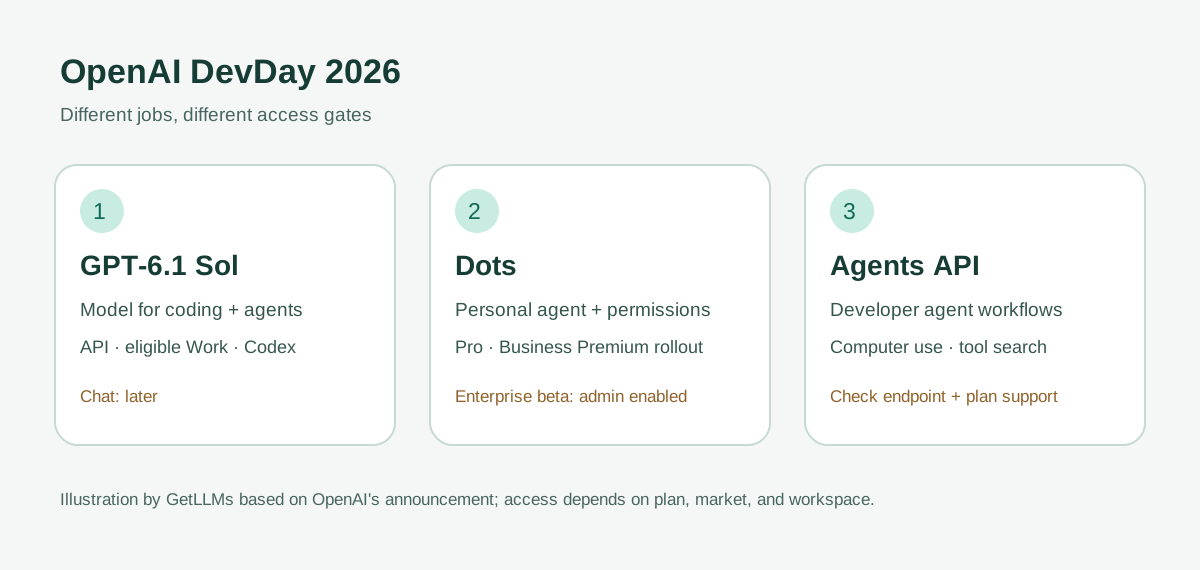
GetLLMs illustration based on OpenAI's DevDay recap. It is a map of announced relationships, not a product screenshot or proof that a feature works in every account.
The model and personal agent
GPT-6.1 Sol is a new coding and agent model. The API ID is gpt-6.1-sol; OpenAI lists 1,050,000 context tokens, 128,000 maximum output tokens, and standard prices of $2 input, $0.10 cached input, and $10 output per million tokens. It is available in the API and eligible paid ChatGPT Work and Codex plans. OpenAI says ordinary Chat access is coming later. Long requests above 272,000 input tokens and speed modes have different rates; read the model contract and pricing page before budgeting a workload. OpenAI's near-Astra performance comparison is a vendor claim, not an independent result.
Dots is a separate personal-agent product powered by GPT-6 Astra. OpenAI describes its own cloud computer and browser, approved connected apps, read-only proactive research, custom rules, and action review. Pro and Business Premium access is rolling out in eligible markets. Enterprise, Edu, and Healthcare receive an administrator-enabled beta that is off by default. A Dot can use a person's laptop only after access is granted. The Dots launch explains its permissions and usage allowance; an example task in the announcement is not evidence of universal task success or availability.
Developer tools and model speed
The Agents API adds computer use, multi-agent work, tool search, and compaction for developers. OpenAI also announced managed agents with Amazon Bedrock. Check the endpoint, account, and region that matter to your application; an API announcement does not establish every tool on every model or plan.
Ultrafast is a separate speed mode, not a new base model. OpenAI reports up to 8× speed in Codex and up to 6× through the API in its comparisons. GPT-6 Astra Ultrafast is listed for the API and eligible Pro 500 and Enterprise work access; GPT-6.1 Sol Ultrafast was announced as coming soon. The mode guide is the place to verify current rates and route support.
The Decisions API is in limited preview, with a broader release planned for the following days. Treat that timing as a plan, not a current general-availability guarantee.
Codex, plugins, and workspaces
OpenAI announced broader Codex cloud access, CLI voice input, /agents, worktrees, code review across plans, and Codex Security Cloud on eligible Pro, Business, Enterprise, and Edu plans. It also announced plugin extensions across plans, additional plugin creation and discovery, Sites hosting plugins for eligible Business, Enterprise, Healthcare, and Edu organizations, and an MCP Events proposal. A proposed specification is not a final standard.
ChatGPT Space launched for eligible Pro, Business, and Enterprise users on desktop and web. Mobile finding, reading, and sharing were described as available, while mobile creation and editing are later work. Pages launched for eligible Pro, Business, and Enterprise users; collaborative slides were described as coming in weeks. Business and Enterprise gained team tasks and Slack or Teams @ChatGPT, while the meeting plugin began as a beta for Pro and Business. OpenAI also announced profiles, Sign in with ChatGPT, a Pro $500 tier, and a limited software marketplace beta. The recap lists the exact plan and rollout notes for each surface.
Privacy announcements and the decision to try
OpenAI introduced Private Intelligence and described zero-data-retention with Private Safety Processing. Private Inference was described as a preview coming this fall. These are different privacy and availability claims; do not treat a future inference preview as live in every account or infer a data policy for another product from its name.
If you need a model for code or agents, start with the GPT-6.1 Sol guide and compare your own accepted results, token use, cache hits, latency, and access. If you need a personal assistant with connected apps, start with the Dots guide and inspect permissions and action review in your account. For an announced API or workspace feature, check its current product documentation and plan gate before planning a migration.