Tailscale
Tailscale is a connectivity tool that builds a private mesh network, called a tailnet, using WireGuard encryption. For AI work, it can connect your laptop or phone to a model server or agent running on another machine. The model runner provides inference; Tailscale provides the network path and access controls.
Start with the official Serve guide ↗Why it matters
A GPU workstation can stay at home while you use its model from another device. The useful decision is which service to expose, who should reach it and where inference actually runs. Connectivity alone answers none of the model-quality or agent-permission questions.
What Tailscale adds to a local AI stack
Tailscale connects devices across networks and prefers direct connections where possible; restrictive networks can require a relay. Do not assume every connection is direct or that latency will meet a particular target. Model loading, generation speed and available memory still depend on the inference host.
- Official local-AI walkthrough and video
Watch the publisher’s Ollama and Open WebUI setup on its original page.
- Ollama can serve the model API, while Open WebUI supplies a browser interface. Tailscale’s May 2025 walkthrough demonstrates these separate roles in a self-hosted stack.
- A private connection does not prove that prompts remain on that host. A selected cloud model, external tool or provider API can send data elsewhere; check the complete request path.
Reach a local Ollama service privately
This is a documentation-based setup illustration, not an executed GetLLMs test. Install and authenticate Tailscale on both supported devices, confirm the model works on its host, enable tailnet HTTPS for Serve and explicitly review the access policy. Ollama’s documented default is 127.0.0.1:11434; keep that loopback listener for this same-host proxy example.
- Current Serve CLI syntax
Review targets, foreground operation and status commands for your client version.
- Ollama local networking FAQ
Confirm the default listener and proxy requirements.
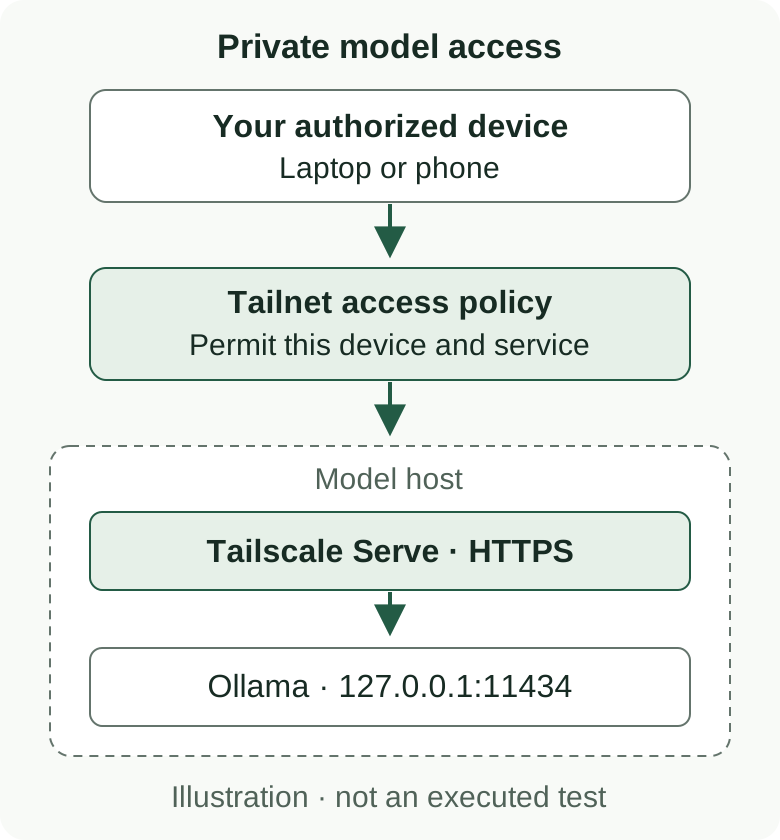
Illustration of a private same-host proxy path. Original GetLLMs diagram based on documented behavior, not an executed setup or performance test. The policy must permit the requesting device.
- On the Ollama host, the current Serve CLI accepts a local port as its target: tailscale serve 11434. It proxies to the local service and prints a tailnet HTTPS URL. Follow the platform-specific requirements in the CLI documentation.
- On the other authorized device, use the exact printed HTTPS hostname with the model client’s required API path. Its own localhost points to that device, not the remote Ollama host.
- An Open WebUI deployment can instead expose its own listening port through Serve. Retain application authentication and configure its model connection separately; sharing the web interface and sharing the raw model API are different choices.
- Keep the initial Serve session in the foreground; Ctrl+C ends it. Check tailscale serve status before relying on an existing configuration or changing exposure.
Choose private Serve or public Funnel
Serve shares a service within your tailnet. Funnel intentionally makes a service reachable from the public internet, including people without Tailscale. A working HTTPS URL does not tell you which audience has access: verify the configured exposure. Serve and Funnel cannot share the same port simultaneously; the latest configuration for that port determines its exposure.
- Funnel’s public-access boundary
Read what becomes public before enabling Funnel.
- For private model access, start with Serve. Funnel needs a separate decision about public access and application-level protection.
- For OpenClaw, Tailscale explicitly recommends Serve rather than Funnel. Avoid turning a personal agent’s powerful interface into a public entry point.
Limit access without trusting the agent
Plan access from default deny: identify the specific user or device, destination and service port that need permission, then grant only that path. This is a least-privilege design recommendation, not a claim that every new tailnet already has a restrictive policy. Serve follows the tailnet’s access rules.
- OpenClaw connectivity and safety guidance
Read Tailscale’s explanation of what its networking and gateway controls can change.
- Agent Skill Security
Review tool permissions and untrusted instructions beyond the network boundary.
- Keep application authentication, narrow tool permissions and sensitive-file boundaries. A permitted network request can still trigger an unsafe action inside an overpowered agent.
- Tailscale’s OpenClaw guidance separates reduced network exposure and credential control from agent safety. Prompt injection, unintended commands and excessive provider spending remain possible.
Aperture adds a separate AI gateway
Aperture is Tailscale’s AI gateway, generally available since August 26, 2026. It centralizes provider credentials and adds usage visibility, cost controls and access management. Ordinary private model connectivity does not require adopting this additional gateway.
- Aperture GA announcement and demonstration
See the August 2026 gateway announcement and publisher video.
- Configure an Aperture self-hosted provider
Check supported API formats, reachability and path handling.
- Aperture can optionally route to a self-hosted OpenAI-compatible model server. The client and provider must support the same API format; a familiar URL shape does not guarantee every client feature works.
- The gateway must reach the model server. Its localhost means the gateway machine. Check upstream base URLs and request paths together to avoid a duplicated /v1 prefix; registering a model does not install it.
Diagnose failures and check the real costs
A successful ping is only a connectivity clue. First confirm that the service responds locally, then check its listening address and port, the Serve proxy target, the exact client hostname and API path, and the applicable access rule. A browser-interface failure can also differ from an API failure. Change one layer at a time rather than broadening access to diagnose everything.
- Check current Tailscale pricing
Compare Personal eligibility, user limits and resource allowances.
- As checked November 16, the Personal plan costs $0 for non-commercial use by up to six users, with separate resource and feature limits. Verify the live terms before choosing it for your use case.
- Free connectivity is not free inference. Hardware, electricity, hosted compute, provider tokens and any separately selected gateway offering have their own costs.
Useful first jobs
- Reach a home model server from an authorized laptop or phone.
- Keep a self-hosted agent interface within a reviewed tailnet access boundary.
- Decide whether a separate gateway is needed for provider credentials and usage controls.
Frequently asked questions
Does Tailscale run the AI model?
No. A runner such as Ollama performs inference on the selected host; Tailscale connects authorized devices to it. A cloud provider remains a separate inference destination.
Should I use Serve or Funnel for a private model?
Use Serve for tailnet-only access. Funnel intentionally opens a public entry point, so it requires a separate public-exposure decision and appropriate application protection.
Why does ping work but the model API fail?
Ping does not prove that the model service is listening or that its API path is correct. Check the local service, port, proxy target, client endpoint and access policy separately.
Does Tailscale make an autonomous agent safe?
No. Restricting who can connect does not remove prompt injection or unrestricted shell, file and tool risks. Limit the agent’s permissions independently.
Is Tailscale free for local AI?
The Personal plan is currently $0 for non-commercial use by up to six users within its published limits. That does not pay for model hardware, electricity, hosted inference or provider tokens.
Sources and evidence
Checked November 16, 2026 against Tailscale and Ollama documentation, Tailscale’s local-AI and OpenClaw guides, the August 26 Aperture GA announcement and current pricing. The setup below combines documented behavior; GetLLMs has not installed or independently tested this stack.
- What is Tailscale? ↗
Tailscale · Primary source
- Tailscale Serve ↗
Tailscale · Primary source
- Serve CLI reference ↗
Tailscale · Primary source
- Tailscale Funnel ↗
Tailscale · Primary source
- Ollama local FAQ ↗
Ollama · Primary source
- Self-host a local AI stack — May 29, 2025 ↗
Tailscale / Alex Kretzschmar · Primary source
- OpenClaw, Aperture and Serve — March 24, 2026 ↗
Tailscale / Kevin Purdy · Primary source
- Aperture general availability — August 26, 2026 ↗
Tailscale / Remy Guercio · Primary source
- Aperture self-hosted providers — validated September 29, 2026 ↗
Tailscale · Primary source
- Tailscale pricing ↗
Tailscale · Primary source